


Christian Symbols in Jerusalem — Every Cross, Emblem and Sign Explained
Posted by Brother Oscar

Reading the Stone — A Complete Guide to Jerusalem's Christian Crosses and Sacred Symbols
Walk slowly through the Old City and you begin to notice something. Above a doorway in the Christian Quarter, a cross is carved into limestone — not the simple upright bar you might expect, but a large cross surrounded by four smaller ones, balanced in each corner of the design. A few streets away, on the dome of a monastery, a Russian Orthodox cross rises in three tiers, its lowest bar tilted at an angle whose meaning is written in the Gospel of Luke. Outside the Armenian Cathedral, a stone panel is filled with an interlace so precise, so impossibly fine, that it barely looks possible in solid rock. At the Church of the Holy Sepulchre, the oldest Christian monogram in the world — two Greek letters merged into a single sign — is carved into stonework that has stood through empire and siege and earthquake.
These are not decorations. Each one is a compressed statement of what a community believes — about Christ, about the Church, about salvation. Jerusalem has been a gathering point of Christian traditions since the earliest centuries of the faith, and the symbols its communities have placed on their walls, gates, vestments, and sacred objects amount to a theological library written in stone, metal, and paint. This guide is how to read it.
You do not need a theology degree. You need only attention — and a willingness to let each symbol speak on its own terms.

The Jerusalem Cross — Symbol of the Crusaders and Pilgrims
The Jerusalem Cross, also known as the Crusader's Cross, features a large central cross surrounded by four smaller crosses — one in each quadrant of the design. This arrangement is sometimes called the Five-Fold Cross, referring to its five separate crosses together. It was first used by Godfrey of Bouillon, the inaugural ruler of the Kingdom of Jerusalem following the First Crusade in 1099, and from that point became the official emblem of the Latin Kingdom of Jerusalem.
The symbolism is layered and has attracted multiple interpretations across the centuries. The large central cross represents Christ. The four smaller crosses are most commonly read as representing the Four Evangelists — Matthew, Mark, Luke, and John — who carried the Gospel to the four corners of the earth. A second reading connects the five crosses to the five wounds of Christ in His Passion: the two hands, the two feet, and the wound in His side. A third sees in the design the universal reach of the Christian mission, with the four smaller crosses marking the cardinal directions.
Today, the Jerusalem Cross appears on church vestments, liturgical art, and devotional objects throughout the city. It is used across Catholic, Orthodox, and Anglican traditions — a symbol that transcended the Crusader context in which it was formalised and became one of the most universal emblems of Christian Jerusalem. The full history and meaning of the Jerusalem Cross repays deeper reading for any pilgrim. Crosses carved by hand in Bethlehem from local olive wood — the same wood growing in the valleys where Christ walked — carry this symbol with a weight that no manufactured reproduction quite matches. Our olive wood Jerusalem crosses are made by Christian families who have worked this craft for generations.

The Latin Cross — A Universal Christian Symbol
The Latin Cross — also known as the Roman Cross — is the most recognised symbol of Christianity worldwide. Its vertical beam extends above the crossbeam and continues further below it, distinguishing it from the equal-armed Greek cross. In Latin it was called the crux immissa or crux capitata. Its asymmetric form — the longer lower beam suggesting the cross as it stood in the ground at Golgotha — makes it the most direct visual reference to the historical event of the Crucifixion.
"For the message of the cross is foolishness to those who are perishing, but to us who are being saved it is the power of God." (1 Corinthians 1:18)
In Jerusalem, the Latin Cross adorns Catholic churches, Franciscan chapels, and personal devotional items throughout the city. It is used across Roman Catholic, Protestant, and Anglican traditions, making it the most broadly ecumenical of all Christian cross forms. Along the Via Dolorosa, large wooden Latin crosses are carried by pilgrims every Friday — tracing the same path Jesus walked on the afternoon of His Passion. At the tenth Station, a carved stone Latin cross leans against the ancient wall where tradition says the soldiers stripped Jesus of His garments. Nowhere does this simplest of symbols feel more precisely located than here.

The Orthodox Crosses — Diverse Symbols of Eastern Christianity
Eastern Christianity is represented in Jerusalem by a rich variety of cross forms, each carrying distinct theological meaning and cultural identity. These crosses are prominently displayed in the monasteries, churches, and shrines of the Christian Quarter — and beyond it, across the city's ancient rooftops and carved lintels. Understanding them is understanding something of the deep differences — and deep common ground — between East and West.
The Greek Orthodox Cross features equal-length arms intersecting at the centre — a design sometimes called the crux quadrata. This balanced form symbolises the unity and completeness of God's love, expressed equally in all directions. The Greek Orthodox Church is the largest landowner among the Christian denominations in Jerusalem and one of the principal custodians of the Church of the Holy Sepulchre. The Greek cross appears throughout its churches, mosaics, and ceremonial vestments — a constant marker of one of the oldest continuous Christian communities in the world.

The Russian Orthodox Cross features three horizontal bars on a vertical post — the most theologically detailed of the common cross forms. The top bar represents the inscription placed above Christ's head at the Crucifixion — "Jesus of Nazareth, King of the Jews" (John 19:19), abbreviated in Latin as INRI. The middle bar is the crossbeam where His hands were nailed. The slanted lower bar represents the footrest, and its tilt carries its own meaning: the right side points upward toward the repentant thief who entered paradise, the left side points downward toward the thief who refused mercy — a reference to the account in Luke 23:39–43. Russian Orthodox crosses are often also inscribed with IC XC — the Greek abbreviation for Jesus Christ — and NIKA, meaning victory. Together: Jesus Christ conquers.

The Budded Cross — also known as the Apostles' Cross — features arms ending in three rounded lobes or buds. These trefoil ends carry the cross's deepest symbolism: the three buds on each arm represent the Holy Trinity, and together the twelve buds across the four arms represent the Twelve Apostles. The budding form itself suggests spiritual growth and the living quality of the faith that the Apostles carried across the world. It appears frequently in medieval Christian architecture, liturgical vestments, and iconography throughout Jerusalem. For more, see our dedicated guide to the budded cross.

For a fuller guide to all the Eastern Orthodox cross forms — their history, theology, and the specific meaning of each element — see our complete guide to Orthodox cross meaning.
The Byzantine Cross — Symbol of the Eastern Roman Church
The Byzantine cross — sometimes called the Eastern cross or the patriarchal cross — features a standard upright post with two horizontal bars rather than one: a shorter bar above the standard crossbeam and a longer one at the arms. This double-barred form is associated with the Byzantine Empire and the Eastern Christian world it shaped, and in Jerusalem it appears on church facades, vestments, and architectural details that mark the long reach of Byzantine influence over the city's sacred geography.
The upper shorter bar represents the inscription board placed above Christ's head at the Crucifixion — the titulus bearing the words "Jesus of Nazareth, King of the Jews" (John 19:19), abbreviated as INRI in Latin or INBI in Greek. The longer bar below is the crossbeam of the Crucifixion itself. This makes the Byzantine cross closely related in meaning to the Russian Orthodox cross — both preserving the titulus in their design — though the Byzantine form omits the slanted footrest bar and carries a cleaner, more architectural profile. The double-barred cross also appears as the patriarchal cross in Western Christianity, where it is associated with senior ecclesiastical authority, but in the Eastern tradition its roots are specifically Byzantine.

Jerusalem was the spiritual heart of the Byzantine world for more than three centuries — from Constantine's building of the Church of the Holy Sepulchre in the fourth century to the Arab conquest of 638. During that period, Byzantine emperors funded the construction of churches, monasteries, and pilgrimage infrastructure across the city, and the Byzantine cross was stamped on everything from mosaic floors to processional banners. Many of those foundations still stand, absorbed into later structures but still carrying the proportions and stonework of their Byzantine origins. The Greek Orthodox community in Jerusalem is in many ways the direct heir of that Byzantine tradition, and the Byzantine cross continues to appear in its churches and ceremonial objects as a mark of that long continuity.
The Tau Cross — An Ancient Symbol Adopted by Christianity
The Tau Cross takes the form of the Greek letter T — a single crossbeam resting on a vertical post, with no upward extension above it. It is one of the oldest cross forms, predating Christianity by centuries, and carries meaning drawn from both the Hebrew scriptures and the Christian tradition. In Ezekiel 9:4, God instructs an angel to place a mark — interpreted by many early Christians as a Tau — on the foreheads of the righteous to spare them from punishment. This protective significance made the Tau a natural symbol for early Christians, who saw it as a forerunner of the Cross of Christ.
The Tau Cross is most closely associated with Saint Francis of Assisi, who adopted it as his personal emblem. He used it as a signature, drew it on the walls of the hermitages where he prayed, and saw in it a representation of Christ's cross and a sign of salvation. "May I never boast except in the cross of our Lord Jesus Christ, through which the world has been crucified to me, and I to the world." (Galatians 6:14) The Franciscan Order — which has maintained custody of many of Jerusalem's holiest sites since 1217 — continues to use the Tau as a central emblem of its identity throughout the Christian Quarter of Jerusalem. Walk through the Christian Quarter today and you will find it on doors, walls, vestments, and medallions worn by the brown-robed friars who still keep vigil at these sites.

In Jerusalem, the Tau Cross appears on Franciscan buildings, liturgical items, and devotional art throughout the city, including at the Via Dolorosa and the Church of the Holy Sepulchre. It is a reminder that the Franciscan presence in this city stretches back eight centuries — and has never broken.
The Custody of the Holy Land Emblem
The Custody of the Holy Land — Custodia Terrae Sanctae — was established in 1217 by Saint Francis of Assisi and formally appointed as custodian of Jerusalem's holy sites by papal decree in 1342. It is the Franciscan institution responsible for maintaining Christian presence at the holiest places in the Holy Land on behalf of the Catholic Church — a role it has held, without interruption, for more than eight hundred years.
Its emblem combines the Jerusalem Cross with the arms of Christ and Saint Francis crossed over each other — Christ's arm bearing the wound of the nail, Francis's arm bearing the stigmata — enclosed within a shield. Around the emblem are the words Custodia Terrae Sanctae. This symbol appears on Franciscan buildings, gates, and churches throughout Jerusalem and the Holy Land, most visibly on the great wooden doors of the custody's headquarters near the Church of the Holy Sepulchre. It is a mark of eight centuries of continuous custodianship at the places where the Gospel was lived — and a reminder that the presence of the Church in Jerusalem has never depended only on emperors or powers, but on men willing to stay.

The Chi-Rho — One of the Earliest Christian Symbols
The Chi-Rho (☧) combines the first two Greek letters of the word Χριστός — Christ — forming one of the earliest Christian monograms. The Chi (Χ) and Rho (Ρ) are superimposed, with the Rho's vertical stroke rising through the intersection of the Chi's crossed arms. Sometimes the Alpha and Omega are added to either side, completing a statement of identity: Christ, who is the beginning and the end.
The Chi-Rho appears in Jerusalem's early Christian catacombs, church mosaics, and archaeological sites, marking the presence of the earliest Christian communities — people who used this sign at a time when an openly displayed cross could still attract danger. The symbol gained imperial significance when Emperor Constantine adopted it as his battle standard following a vision before the Battle of Milvian Bridge in 312 AD — accompanied, according to tradition, by the words In hoc signo vinces: In this sign, you will conquer. His subsequent victory and conversion transformed Christianity's relationship with the Roman Empire, and with Jerusalem itself. Helena, his mother, came to the city soon after and is credited with identifying the site of the Crucifixion — the same site now enclosed within the Church of the Holy Sepulchre through the ages.
In Jerusalem, the Chi-Rho appears on ancient artefacts, carved stonework, and liturgical objects throughout the city — a reminder of the moment when the faith of a persecuted minority became the faith of an empire, and when Jerusalem became, for the first time, a city of official Christian pilgrimage.

The Alpha and Omega — Symbols of Eternity
The Alpha (Α) and Omega (Ω) — the first and last letters of the Greek alphabet — appear frequently alongside crosses in Jerusalem's churches, mosaics, vestments, and even on the decorative ironwork of gates and window grilles. Their significance derives from Christ's own words in the Book of Revelation: "I am the Alpha and the Omega, the First and the Last, the Beginning and the End." (Revelation 22:13) These letters are not merely decorative — they are a theological claim, stating that Christ pre-exists creation and will outlast it.
The symbol appears most often flanking the Chi-Rho or placed on either side of a cross. In Jerusalem's older churches, you will find them in floor mosaics, in the painted domes of Byzantine chapels, and carved into architectural stonework from every century of Christian occupation. The combination of Alpha, Omega, and Chi-Rho was the dominant visual language of early Christianity before the cross became its central emblem — and in Jerusalem, where layers of Christian centuries lie one beneath another, you will often see all three together in a single composition.

The IHS Monogram — Name Above All Names
The IHS monogram is one of the most widely seen yet least explained symbols in Jerusalem's Catholic and Jesuit-associated churches. It derives from the first three letters of the Greek name for Jesus — ΙΗΣΟΥΣ (Ihsous) — rendered in Latin script as IHS. Sometimes a cross rises from the H, and three nails are placed beneath the letters, connecting the name of Jesus directly to the event of the Crucifixion.
The symbol was popularised in the fifteenth century by Saint Bernardino of Siena, who promoted it as a devotional emblem to replace the insignia of rival political factions. The Jesuit Order later adopted it as its own, and it appears prominently in Jesuit-founded churches and institutions worldwide — including several in Jerusalem. You will also find IHS embroidered on Franciscan vestments and stamped onto liturgical objects throughout the Latin churches of the Old City. Where the Chi-Rho belongs to the ancient and Eastern Christian world, the IHS is the mark of Western Catholic devotion from the medieval period onward. The two symbols sometimes appear together in the same space, making Jerusalem's churches among the few places in the world where two thousand years of Christian visual language coexist on the same walls.

The INRI Inscription — The Title Above the Cross
Of all the words associated with the Crucifixion, four letters have become among the most recognised in Christian art: INRI. They are an abbreviation of the Latin phrase Iesus Nazarenus Rex Iudaeorum — Jesus of Nazareth, King of the Jews. According to the Gospel of John, Pontius Pilate ordered this inscription placed on a board above Christ's head as He hung on the cross. Pilate wrote it himself, and when the chief priests objected and asked him to change the wording, he refused: "What I have written, I have written." (John 19:22)
What makes this inscription uniquely Jerusalemite is what John records next: "Many of the Jews read this sign, for the place where Jesus was crucified was near the city, and the sign was written in Aramaic, Latin and Greek." (John 19:20) Three languages — the sacred tongue of Israel, the administrative language of Rome, and the common language of the Mediterranean world — all present at once on a single board, on a single hill, on a single afternoon. In that moment, Jerusalem was not just the city of the Jews or the city of Rome. It was the meeting point of the whole known world, and the inscription above the cross announced Christ's kingship in every direction simultaneously.
In Jerusalem today, INRI appears on crucifixes in every church of every tradition — Catholic, Orthodox, Protestant, Armenian, Coptic — carved in wood, cast in bronze, painted in gold, etched in stone. It is one of the few inscriptions that all Christian traditions share without dispute. At Golgotha, the rock of Calvary preserved inside the Church of the Holy Sepulchre, pilgrims reach beneath the altar to touch the stone where the cross once stood — and above them, in nearly every representation of the scene, those four letters are present. They were written in mockery. They became proclamation. And in Jerusalem, where they were first displayed, they have never stopped being read.
The Taphos — Symbol of the Holy Sepulchre
The Taphos symbol is exclusive to the Church of the Holy Sepulchre and to the Greek Orthodox Brotherhood of the Holy Sepulchre. Its name derives from the Greek words forming the concept of tomb or sepulchre — reflecting the Brotherhood's custodial role at the site of Christ's burial and Resurrection.
Following the East-West Schism of 1054, the Greek Orthodox Church gradually gained significant custodial rights over the Church of the Holy Sepulchre. The Brotherhood of the Holy Sepulchre, established in the sixteenth century, became the guardian of those rights — and the Taphos emblem became their mark of presence and authority. It is engraved on the keystones of buildings constructed by the Greek Patriarchate throughout Jerusalem, appearing on doorways, cornerstones, and architectural details across the Old City. For those who know to look for it, the Taphos is everywhere — a quiet but pervasive sign of Greek Orthodox custodianship running through the bones of the city's architecture. The chapels of the Holy Sepulchre are where this custodianship is most visibly expressed.

The Coptic Cross — The Heritage of Egyptian Christianity
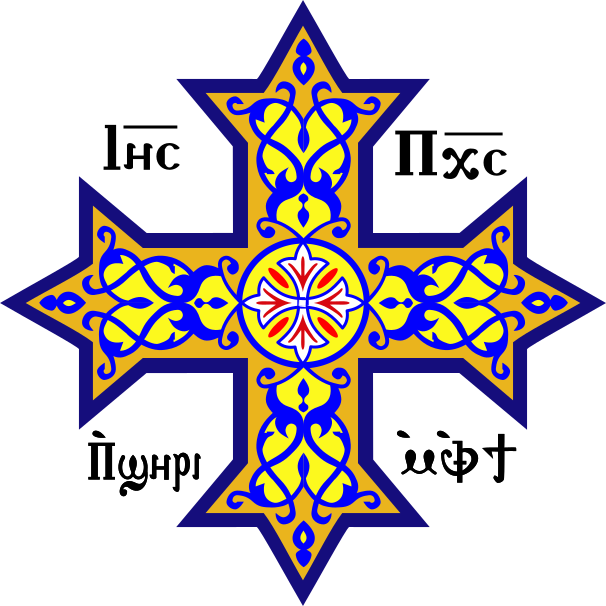
The Coptic Cross, used by the Coptic Orthodox Church, features bold equal arms often decorated with intricate geometric patterns — circles, dots, and interlocking lines that give it an immediately distinctive appearance. It is one of the most visually striking of Jerusalem's crosses, recognisable at once for its ornamentation and its connection to one of the world's oldest Christian traditions.
The Coptic Church traces its origins to Saint Mark the Evangelist, believed to have founded the Church of Alexandria in the first century. Coptic Christians see their cross as a symbol of spiritual resilience — their community has maintained its faith across centuries of difficulty and change, and the cross they carry reflects that endurance. Some scholars see in the Coptic cross a visual echo of the ancient Egyptian ankh, the symbol of life, suggesting a continuity between Egypt's ancient spiritual heritage and its Christian transformation — though Coptic Christians themselves primarily understand the cross as a symbol of the Resurrection.
In Jerusalem, Coptic crosses appear in the chapels and monasteries of the Christian Quarter, including the Coptic Patriarchate and the monastery situated on the roof of the Church of the Holy Sepulchre — one of the most unusual and affecting sacred spaces in the entire city. The Coptic community in Jerusalem is small but ancient, and their cross is a reminder that the Christianity of the Holy Land was never a monolith but always a family of traditions, each with its own history and its own way of bearing the same symbol.
The Ethiopian Cross — Africa's Oldest Christian Presence
The Ethiopian Orthodox Tewahedo Church is one of the oldest Christian churches in the world, tracing its origins to the baptism of the Ethiopian eunuch by Philip the Evangelist, recorded in Acts 8:26–39. Ethiopia adopted Christianity as its state religion in the fourth century — making it one of the first nations on earth to do so — and its presence in Jerusalem stretches back almost as far. Ethiopian monks have prayed in this city for over a millennium, and their community maintains one of the most unusual outposts in the entire Old City: a cluster of simple dwellings and a chapel on the roof of the Church of the Holy Sepulchre, reached by a staircase that rises above the Coptic monastery next door.
The Ethiopian cross is among the most visually distinctive in Jerusalem. Processional crosses — carried on long staffs during liturgical ceremonies — are typically ornate and highly detailed, fashioned from gilded brass or silver and featuring elaborate geometric latticework, often incorporating circular or star-shaped motifs at the ends of the arms. Smaller hand crosses held by priests during worship share the same intricate character. The patterns filling the cross arms are not merely decorative — they draw on a visual language of interlace and sacred geometry that connects Ethiopian Christian art to its ancient roots, while remaining entirely its own. No other tradition in Jerusalem produces crosses that look quite like these.

The Ethiopian community's position in Jerusalem has not always been secure. A long-running dispute with the Coptic Orthodox Church over rights to the rooftop space — one of the more extraordinary territorial disagreements in the city — reflects the complex web of custodial claims that governs every corner of the Old City's sacred geography. Through it all, the Ethiopian monks have remained, keeping their liturgy, their language, their crosses, and their quiet vigil above one of the holiest sites in Christendom.
The Armenian Khachkar — Stone Crosses of a Surviving People
The Armenian Apostolic Church has maintained a presence in Jerusalem since the fourth century. The Armenian Quarter of the Old City is one of the oldest continuously inhabited Armenian communities in the world — a people who have lived beside the Church of the Holy Sepulchre through Crusades, Mamluk rule, Ottoman centuries, and the modern era, always keeping their own language, their own liturgy, and their own visual tradition.
At the heart of that tradition is the khachkar — literally "cross-stone" in Armenian. A khachkar is a carved stone slab, typically rectangular, featuring an ornate central cross set within an intricate lattice of interlaced foliage, geometric patterns, and symbolic motifs. No two khachkars are identical. Each is designed to be unique, a singular expression of the carver's art, and the finest examples — some dating to the ninth and tenth centuries — are considered among the masterpieces of medieval Christian art in any tradition.

The symbolism is rich. The cross at the centre is understood as the Tree of Life, and the interlacing patterns around it represent the eternal, unbroken nature of divine love. The rosette motifs frequently incorporated into the design connect to resurrection symbolism — flowers blooming from stone, life emerging from apparent death. Armenian pilgrims have brought khachkars to Jerusalem for centuries, and they appear throughout the Armenian Quarter, in the Cathedral of Saint James, and along the walls of the community's courtyard spaces. The Armenian Patriarchate's emblem — combining traditional Armenian cross forms with inscriptions in the Armenian script — appears above the quarter's entrance, announcing a presence that nothing has succeeded in erasing.

The Ichthys — An Early Christian Emblem
The Ichthys — the fish symbol — is one of the earliest emblems used by Christians, predating the widespread use of the cross as a devotional image. Found on early Christian catacombs, ancient tombs, and artefacts throughout Jerusalem and the wider Holy Land, it marks the presence of the earliest Christian communities — people who met in private homes, prayed in secret, and needed signs that could be read by friends without being understood by those who meant them harm.
The Greek word for fish, ἰχθύς, forms an acronym for the earliest Christian confession of faith: Ἰησοῦς Χριστός Θεοῦ Υἱός Σωτήρ — Jesus Christ, Son of God, Saviour. During periods of Roman persecution, the Ichthys served as a covert identifier. One Christian could draw half the fish in the dirt; another could complete it, confirming their shared faith without betraying themselves. The symbol is also deeply connected to the Eucharist, recalling Christ's multiplication of the loaves and fishes (John 6:1–14) and His words to the disciples: "Come, follow me, and I will make you fishers of men" (Matthew 4:19). In Jerusalem, where the earliest Christian community gathered in the years immediately following the death and Resurrection of Jesus, the Ichthys is a reminder that the faith which now fills the city's great churches began in smaller, quieter, more hidden places.

The Anchor Cross — Hope Written in Stone
The Anchor Cross is among the earliest symbols found in Christian burial sites — predating, in many cases, the open display of the cross itself. An anchor whose upper curve forms the arms of a cross, it appears in the catacombs of Rome and in early Christian artefacts found throughout the Holy Land, placed on the tombs of believers as a sign of the hope they carried into death. Its scriptural source is explicit: "We have this hope as an anchor for the soul, firm and secure." (Hebrews 6:19)
The genius of the symbol lay in its concealment. To a Roman official, an anchor was simply an anchor — a maritime symbol with no religious significance. To a Christian, it was a cross in disguise: the vertical post, the crossbeam, and the curved lower section together forming the unmistakable shape of the instrument of salvation. At a time when openly displaying a cross could invite persecution, the anchor allowed believers to mark their tombs and meeting places with their faith without announcing it to hostile eyes. It was a symbol of dual belonging — to the world above, and to the hope of the world to come.

In Jerusalem, anchor crosses appear in the archaeological record of the early Christian community, particularly in burial contexts around the city. The symbol appears less frequently on the walls of Jerusalem's standing churches than the cross forms that became dominant after Constantine's legalisation of Christianity — by which point the need for concealment had passed. But in the city's museums and excavation sites, and occasionally carved into the stonework of ancient burial chambers, the anchor cross surfaces as a quiet reminder of the generation that believed before believing was safe.
The Dove — Symbol of the Holy Spirit
The dove is one of the oldest and most universal symbols in the Christian tradition, and in Jerusalem it appears in mosaics, church ceilings, baptismal fonts, and devotional art throughout the city. Its significance is rooted in one of the most decisive moments in the Gospel narrative: the baptism of Jesus in the Jordan River.
"And when Jesus was baptised, immediately he went up from the water, and behold, the heavens were opened to him, and he saw the Spirit of God descending like a dove and coming to rest on him; and behold, a voice from heaven said, 'This is my beloved Son, with whom I am well pleased.'" (Matthew 3:16–17)
At the moment of Christ's baptism — in the river whose baptism sites along the Jordan still draw pilgrims today — the Holy Trinity was revealed simultaneously for the first time: the Father speaking, the Son standing in the water, the Spirit descending in the form of a dove. The dove also carries meaning drawn from Genesis, where it was a dove carrying an olive branch that told Noah the waters had receded and the earth was renewed (Genesis 8:11) — making it a symbol of peace, reconciliation, and new life long before the New Testament gave it its Trinitarian dimension. It is one of the symbols that crosses denominational lines most easily — Catholic, Orthodox, Protestant, and Coptic Christians all use the dove to represent the Holy Spirit without dispute.

The Lamb of God — Agnus Dei
"The next day he saw Jesus coming toward him, and said, 'Behold, the Lamb of God, who takes away the sin of the world!'" (John 1:29)
The Lamb of God — Agnus Dei in Latin — is one of the most ancient and theologically layered symbols in Jerusalem's Christian art. It appears in mosaics above church altars, carved into stone lintels, embroidered on liturgical vestments, and depicted in icons throughout the Christian Quarter. The image draws on two converging streams of biblical meaning. The first is the Passover lamb of the Old Testament — the unblemished lamb whose blood marked the doorposts of the Israelites in Egypt, sparing them from the final plague (Exodus 12:1–13). This lamb was not simply a sacrifice; it was a sign of deliverance. Every Passover lamb celebrated in Jerusalem for centuries pointed forward, in Christian understanding, to the one whose blood would mark a boundary of a different kind.
The second stream comes from the Book of Revelation, where Christ appears at the centre of heavenly worship as the Lamb who was slain and yet stands — simultaneously bearing the marks of sacrifice and exercising divine authority: "Worthy is the Lamb who was slain, to receive power and wealth and wisdom and might and honour and glory and blessing!" (Revelation 5:12) In Jerusalem, the Agnus Dei is typically depicted as a white lamb carrying a cross or a banner — the cross representing the Crucifixion, the banner representing the Resurrection victory. For pilgrims walking the Via Dolorosa or praying at the Aedicule of the Empty Tomb, the Lamb of God is a constant visual reminder that the Passion was not an accident of history but the fulfilment of a redemptive pattern woven through Scripture from the very beginning.

The Palm Branch — Jerusalem's Own Symbol
Of all the symbols in this guide, the palm branch is the one most inseparably bound to a specific street, a specific crowd, and a specific moment in Jerusalem's history. When Jesus entered the city riding on a donkey in the days before His Passion, the people spread their cloaks on the road and cut branches from the palm trees, waving them and crying out: "Hosanna to the Son of David! Blessed is he who comes in the name of the Lord! Hosanna in the highest heaven!" (Matthew 21:8–9) The palm branch was the crowd's spontaneous declaration — not a liturgical gesture but a popular one, drawn from the ancient Jewish tradition of waving branches during the Feast of Tabernacles as a sign of joy and royal welcome.
For Christians, this moment — commemorated every year on Palm Sunday at the start of Holy Week — transformed the palm branch into a symbol of Christ's kingship and the hope of salvation. From the earliest centuries of the Church, palm fronds were associated with martyrdom and victory over death, carried by saints in the iconographic tradition as a sign that they had conquered through faith. In Jerusalem, where Palm Sunday is still observed with a procession descending from the Mount of Olives into the city — retracing the route of the original entry — the palm branch is not a distant theological symbol but a living annual event, enacted in the same city where it first happened.

The word palmer — one of the oldest terms for a Christian pilgrim — derives directly from this symbol. From the fourth century onward, those who had made the pilgrimage to Jerusalem carried palm fronds home with them as evidence of their journey, and the palm branch carved above a doorway or woven into a church mosaic became a mark of holy pilgrimage. In Jerusalem's Christian pilgrimage sites, the palm continues to appear in art and architecture as both a symbol of Christ's triumphal entry and a mark of the pilgrim's own arrival in the city that has drawn the faithful for two thousand years.
The Crown of Thorns — A Symbol Uniquely of Jerusalem
Of all the symbols associated with the Passion of Christ, the Crown of Thorns is the most specifically and uniquely Jerusalemite. Unlike the cross, which appears across the entire Christian world, the Crown of Thorns belongs to a single moment, in a single place, on a single afternoon in human history — and that place was Jerusalem.
"And the soldiers twisted together a crown of thorns and put it on his head and arrayed him in a purple robe. They came up to him, saying, 'Hail, King of the Jews!' and struck him with their hands." (John 19:2–3)
The Crown of Thorns was an act of mockery — soldiers twisting thorny branches into a rough circlet and pressing it onto the head of the man they were about to crucify. But for Christians, the mockery became proclamation. The crown placed on Christ in derision was, in the eyes of faith, the most honest crown ever worn — identifying the crucified Jesus as the true King of the Jews, and of the world. In Jerusalem, the Crown of Thorns appears in church mosaics, devotional paintings, and carved stone throughout the Christian Quarter. The Chapel of the Derision inside the Church of the Holy Sepulchre at Golgotha — believed to mark the place where the soldiers mocked Christ and placed the crown on His head — is one of the lesser-known but most affecting spaces in the entire complex.

The symbol carries particular resonance in the Franciscan tradition, connected to the stigmata of Saint Francis, who bore on his own body the marks of the Passion. Franciscan churches and chapels in Jerusalem frequently incorporate the Crown of Thorns into their iconography, alongside the Tau Cross and the Custody emblem. As a devotional symbol, it carries a paradox at its heart: suffering transformed into sovereignty, humiliation revealed as glory, a king crowned not in gold but in the wood and thorn of the very land where he walked.
The Seraphim and Cherubim — Guardians of the Holy
Walk into any of Jerusalem's older Byzantine-era churches and look up. In the apse — the curved recess behind the altar — and in the dome above the nave, you will almost always find them: winged angelic figures surrounding Christ in glory, their wings spread in patterns that fill the curved plasterwork or mosaic surface of the ceiling. These are the Seraphim and Cherubim, the highest orders of the angelic hierarchy, and in Jerusalem's sacred art they appear as constantly as any cross.
The Seraphim come from Isaiah's vision in the Temple: "Above him were seraphim, each with six wings: with two wings they covered their faces, with two they covered their feet, and with two they were flying. And they were calling to one another: 'Holy, holy, holy is the Lord Almighty; the whole earth is full of his glory.'" (Isaiah 6:2–3) Six-winged, face-covering, crying out the Trisagion — the threefold Holy — the Seraphim are the beings closest to the divine presence, and their image in church architecture places every worshipper beneath the same heavenly liturgy Isaiah witnessed. The Cherubim, described in Ezekiel's vision as four-faced creatures bearing the divine throne-chariot across the heavens (Ezekiel 1:4–28), appear in mosaics as the four living creatures of Revelation — the lion, the ox, the eagle, and the human face — which Christian tradition identified with the Four Evangelists.

In Jerusalem, these figures appear most prominently in the apse mosaics of the Church of the Holy Sepulchre's rotunda, in the dome compositions of Greek Orthodox and Armenian churches throughout the Old City, and in the illuminated manuscript tradition preserved in the city's monastic libraries. They are not decorative — in Byzantine theological aesthetics, the church interior was understood as an image of heaven, and the Seraphim and Cherubim in the ceiling made that claim visible. To stand beneath them in Jerusalem, in a church built over the ground where Christ was crucified and buried, is to feel the full weight of that theology in a way no other city quite makes possible.
The Star of David on Christian Sites — A Shared Symbol
The six-pointed star — today universally recognised as the Star of David and closely associated with Judaism — has a more complex history in Jerusalem's Christian sacred spaces than is commonly understood. Long before it became the dominant symbol of Jewish identity, the hexagram appeared across a wide range of religious and cultural contexts in the ancient Near East, and in the early centuries of the Church it was used by Christians as a geometric symbol without fixed religious meaning.
In Jerusalem's Byzantine-era church floors — many of which survive beneath or incorporated into later structures — six-pointed star patterns appear as part of the decorative geometric vocabulary of mosaic art. They were not statements of Jewish identity but expressions of a shared visual language drawn from the ancient world. The same star appears in Islamic architectural decoration, in early Christian iconography, and in Jewish contexts — reflecting the overlapping cultural world of the ancient Middle East in which all three traditions formed. At several sites in and around Jerusalem, excavations have uncovered mosaic floors from early Christian churches featuring hexagram patterns alongside crosses, doves, and vines — all understood within the same decorative programme.

For Christian visitors to Jerusalem, encountering the six-pointed star in a church context is a reminder that the visual boundaries between traditions were once more porous than they later became — and that the city's sacred art was always being made by communities who shared the same stones, the same craftsmen, and often the same geometric patterns, even when their theologies diverged. Jerusalem has always been a place where symbols cross boundaries. The star on a church floor is one of the quieter signs of that.
The Menorah in Early Christian Art — The Light That Carried Forward
The Menorah — the seven-branched lampstand that stood in the Temple of Jerusalem — is one of the oldest sacred symbols in the world, and its presence in early Christian art in Jerusalem is both surprising and, on reflection, entirely logical. In the years immediately following the Crucifixion and Resurrection, the first Christians were Jews who continued to understand their faith as the fulfilment of the covenant God had made with Israel. The Temple was still standing — it would not be destroyed until 70 AD — and the Menorah that burned within it was the central symbol of the divine presence dwelling among His people.
In the mosaics and carved stonework of early Christian churches around Jerusalem — and in the wider Holy Land, particularly in the Galilee and the Jordan Valley — the Menorah appears alongside Christian symbols such as the Chi-Rho, the fish, and the cross. At sites like the mosaic floors of early Christian basilicas in the region, the Menorah is placed not as a borrowed motif but as a symbol understood within a continuous theological story: the light of the Temple, which the Hebrew scriptures described as burning perpetually before the Lord (Exodus 27:20–21), was read by early Christians as a prefiguring of Christ, "the light of the world" (John 8:12), whose coming did not abolish the Law but fulfilled it.

By the Byzantine period, the Menorah had largely disappeared from Christian artistic programmes as the tradition developed its own distinct visual language. But in Jerusalem — where the earliest layers of Christian history lie closest to the surface — its occasional presence in excavated church floors and early artefacts is a testament to the Jewish roots of the faith and to the particular character of this city, where the story of Scripture did not begin with the New Testament but with the creation of the world, and where the symbols of that longer story are still visible in the stone.
All Jerusalem Symbols at a Glance
Jerusalem's Christian symbols span two thousand years and a dozen traditions. This table gathers them in one place — the symbol, the tradition that uses it most, and the single core meaning at its heart.
| Symbol | Primary Tradition | Core Meaning |
|---|---|---|
| Jerusalem Cross | Catholic, Orthodox, Anglican | Five wounds of Christ; the Gospel carried to the four corners of the earth |
| Latin Cross | Catholic, Protestant, Anglican | The cross of the Crucifixion at Golgotha; the historical event of redemption |
| Greek Orthodox Cross | Greek Orthodox | God's love expressed equally in all directions; unity and completeness |
| Russian Orthodox Cross | Russian Orthodox | The Crucifixion in full detail: inscription, crossbeam, footrest, the two thieves |
| Budded Cross | Catholic, Orthodox | The Twelve Apostles; the Holy Trinity; the living, flowering growth of faith |
| Byzantine Cross | Greek Orthodox, Eastern Catholic | The titulus above Christ's head; Byzantine imperial and ecclesiastical authority |
| Tau Cross | Franciscan | Ancient protective mark; Francis's personal emblem of the cross of salvation |
| Custody of Holy Land Emblem | Franciscan | Eight centuries of Franciscan custodianship; the arms of Christ and Francis united |
| Chi-Rho | All traditions (early) | The name of Christ; Constantine's conversion; the faith made imperial |
| Alpha and Omega | All traditions | Christ as the beginning and end of all creation; eternal divine authority |
| IHS Monogram | Catholic, Jesuit, Franciscan | The name of Jesus; devotion to the Holy Name in Western Catholic tradition |
| INRI | All traditions | The inscription Pilate placed above the cross; Christ's kingship proclaimed in three languages |
| Taphos | Greek Orthodox | The Brotherhood of the Holy Sepulchre; Greek custodianship of Christ's tomb |
| Coptic Cross | Coptic Orthodox | Egyptian Christian heritage; spiritual resilience; the omnipresence of God |
| Ethiopian Cross | Ethiopian Orthodox | Africa's oldest Christianity; ornate sacred geometry; the faith that never left Jerusalem |
| Armenian Khachkar | Armenian Apostolic | The Tree of Life; the eternal and indestructible nature of the faith |
| Ichthys | All traditions (early) | Jesus Christ, Son of God, Saviour; the secret sign of the persecuted Church |
| Anchor Cross | All traditions (early) | Hope as an anchor for the soul; the cross disguised for a persecuted community |
| Dove | All traditions | The Holy Spirit; the baptism of Christ; peace, reconciliation, new life |
| Lamb of God | Catholic, Orthodox | Christ as Passover sacrifice; the slain Lamb who stands in Revelation's throne room |
| Palm Branch | All traditions | Christ's triumphal entry into Jerusalem; the pilgrim's mark; victory over death |
| Crown of Thorns | Catholic, Franciscan | The Passion; suffering as sovereignty; Christ revealed as King in the moment of humiliation |
| Seraphim and Cherubim | Orthodox, Catholic | The heavenly liturgy; the divine presence; the church interior as an image of heaven |
| Star of David | Early Christian (shared) | Shared geometric heritage; the porous visual boundaries between Jerusalem's ancient traditions |
| Menorah | Early Christian | The light of the Temple; Christ as fulfilment of Israel's covenant; the Jewish roots of the faith |
These symbols do not compete with one another — they complete one another. Each one illuminates a different face of the same mystery, from the angle that a different century, a different people, a different moment of faith has been able to see.
Frequently Asked Questions About Christian Symbols in Jerusalem
What is the most recognised Christian cross in Jerusalem?
The Jerusalem Cross — also called the Crusader's Cross — is the symbol most distinctively associated with the city. Featuring a large central cross surrounded by four smaller crosses, one in each quadrant, it has represented Christian presence in the Holy Land since the First Crusade in 1099.
What is the difference between the Latin Cross and the Orthodox Cross?
The Latin Cross has a single horizontal bar and is the most widely recognised symbol in Western Christianity, used across Catholic, Protestant, and Anglican traditions. The Russian Orthodox Cross features three horizontal bars: the top represents the inscription placed above Christ's head, the middle is the crossbeam, and the slanted lower bar represents the footrest and symbolises the two thieves crucified beside Him.
What is the Tau Cross and why is it associated with the Franciscans?
The Tau Cross takes the form of the Greek letter T and is one of the oldest cross forms, predating Christianity by centuries. Saint Francis of Assisi adopted it as his personal emblem, and the Franciscan Order — which has maintained custody of Jerusalem's holiest sites since 1217 — continues to use it throughout the city.
What does the Chi-Rho symbol mean?
The Chi-Rho combines the first two Greek letters of Christos — Christ — forming one of the earliest Christian monograms. It gained imperial prominence when Emperor Constantine adopted it before the Battle of Milvian Bridge in 312 AD, an event that transformed Christianity's relationship with Rome and with Jerusalem itself.
What is the Ichthys symbol and why did early Christians use it?
The Ichthys is the fish symbol, and the Greek word for fish forms an acronym for the earliest Christian confession: Jesus Christ, Son of God, Saviour. During periods of Roman persecution, it served as a covert identifier — one Christian could draw half the fish, another could complete it, confirming shared faith without risk.
Why are there so many different Christian symbols in Jerusalem?
Jerusalem has been a meeting point of Christian traditions since the earliest centuries of the Church. Catholic, Orthodox, Armenian, Coptic, Ethiopian, and other communities each developed their own symbolic language across two millennia, resulting in a visual landscape where multiple forms of the cross and other emblems coexist within a single square mile.
What is the Taphos symbol found in Jerusalem's Old City?
The Taphos symbol is exclusive to the Greek Orthodox Brotherhood of the Holy Sepulchre, whose name derives from the Greek for tomb or sepulchre. It appears engraved on keystones of buildings constructed by the Greek Patriarchate throughout Jerusalem, marking centuries of Orthodox custodianship at the city's holiest sites.
What is a khachkar?
A khachkar is an Armenian cross-stone — a carved stone slab featuring an ornate, interlaced cross design unique to Armenian Christian art. Every khachkar is one of a kind, and they appear throughout the Armenian Quarter of Jerusalem as markers of one of the oldest continuous Christian communities in the world.
What does INRI mean on a cross?
INRI abbreviates the Latin phrase Iesus Nazarenus Rex Iudaeorum — Jesus of Nazareth, King of the Jews — the inscription Pontius Pilate ordered placed above Christ's head at the Crucifixion. According to the Gospel of John, it was written in Hebrew, Latin, and Greek, the three languages that together represented the entire known world gathered at Jerusalem that day.
Why does the Palm Branch appear in Christian art in Jerusalem?
The Palm Branch is inseparable from Jerusalem because it was the symbol of Christ's triumphal entry into the city on Palm Sunday, when the crowd spread palm fronds along His path. From the fourth century onward, pilgrims who had visited Jerusalem were known as palmers — palm-bearers — because they carried fronds home as proof of their pilgrimage.
Closing Reflection
There is a particular hour in Jerusalem — late afternoon, when the limestone of the Old City turns the colour of honey — when the city's symbols seem less like historical objects and more like living presences. The Taphos on a keystone. The Tau above a Franciscan door. The Russian cross catching the light from a monastery dome. The khachkar shadow falling across the Armenian Quarter's courtyard. The Ethiopian monks keeping vigil on a rooftop above the tomb. None of these was placed here for tourists. Each one was placed here by a community that meant to stay — that has stayed, through everything, because this is the city where the symbols became real.
To read the symbols is to read the community. And to know the community is to understand, at least a little, why Jerusalem has pulled pilgrims toward it for two thousand years. Not because it is comfortable or easy, but because here, the invisible things seem to have pressed themselves into the stone — and left marks that neither time nor politics nor earthquake has been able to erase.
TOPIC:
SHARE:


